8 mansions feng shui is one of the classical concepts of Chinese metaphysics that have strong fundamentals rooted in compass directions.
For this reason, it is also often categorized in modern practice and jargon to belong to the compass school methodologies of feng shui.
The Chinese name for 8 mansions is a Ba Zhai (八宅).
Because Chinese words can carry a a diverse set of meanings, ba zhai can be translate literally to various terms when we get into the specificity.
While the word 八 can be conclusively be determined to mean the number 8, the same conviction cannot be said of the word 宅.
This is because zhai (宅) can be translated to mean house, mansion, dwelling, and basically a place where people inhabit.
So it’s common to find different masters, teachers and academics call 8 mansions with a different name. The most common alternative is “8 house”.
The most famous classical text on 8 mansions feng shui is one written by Yang Yun Song (杨筠松) titled Ba Zhai Ming Jing (八宅明鏡) which can be literally translated as 8 house bright mirror.
It should be noted that the origin of this feng shui concept cannot be attributed to the author. His work helped learners understand the concepts and logic behind 8 mansions, but he is not the creator of the theory itself.
Basic concept of 8 mansions
As the name suggest, 8 mansions feng shui basically classify homes into 8 types of houses. And the 8 types of houses are further segmented into an East group and West group consisting of 4 types each.
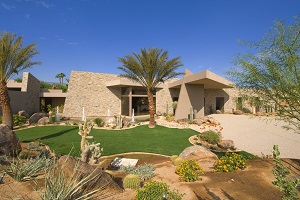
The methodology used to determine the type of house a property is, is to use the sitting direction as reference.
Like flying stars feng shui. the facing of a house is not dependent on the facing of the main door in 8 mansions.
The main door into a property can very well be on another side of a house which is not the facing.
Once the facing direction of a house is identified, then the opposite direction would be the sitting by default.
8 types of houses
8 mansions feng shui has a strong connection with the bagua and it’s placement of trigrams.
So much so that the sitting direction (which determines the type of house) and it’s linkage to trigram positions on the later heaven bagua is used as the term to name these houses.
For example, a house sitting on southwest is called a Kun house as the Kun trgram sits on the southwest in the later heaven bagua arrangement. And because the southwest is associated with the number 2 in the Luo Shu magic squares, such a property can also be termed as a Gua 2 house.
The following table list down the 8 types of houses according to their sitting direction.
| Sitting | Facing | Gua | Group |
| N | S | 1 | East |
| SW | NE | 2 | West |
| E | W | 3 | East |
| SE | NW | 4 | East |
| NW | SE | 6 | West |
| W | E | 7 | West |
| NE | SW | 8 | West |
| S | N | 9 | East |
8 sectors of 8 mansions
Once the type of a house can be recognized, 8 different sectors can be segmented to describe 8 types of chi. These 8 sectors are:
- Sheng Qi (生气)
- Fu Wei (伏位)
- Tian Yi (天医)
- Yan Nian (延年)
- Wu Gui (五鬼)
- Liu Sha (六煞)
- Huo Hai (祸害)
- Jue Ming (绝命)
These 8 sectors can be then be grouped into 4 favorable (吉方) and 4 unfavorable sectors (凶方).
| Gua | SC | TY | YN | FW | 5G | 6K | HH | JM |
| 1 | SE | E | S | N | NE | NW | W | SW |
| 2 | NE | W | NW | SW | SE | S | E | N |
| 3 | S | N | SE | E | NW | NE | SW | W |
| 4 | N | S | E | SE | SW | W | NW | NE |
| 6 | W | NE | SW | NW | E | N | SE | S |
| 7 | NW | SW | NE | W | S | SE | N | E |
| 8 | SW | NW | W | NE | N | E | S | SE |
| 9 | E | SE | N | S | W | SW | NE | NW |
As seen from the above table, it can be observed that for all types of houses, the sitting direction which determines the type of house is always where the fu wei sector is.
The energy map identified by the house also depict the strength of each different sector as the below table shows.
| SQ | TY | YN | FW | 5G | 6K | HH | JM |
| S | S | A | W | S | A | W | S |
With S = Strong; A = Average; W = Weak
The exception is a Kan house where the FW sector is classified as Average instead of weak.
In summary of the 8 different sectors, it can be said that:
- Sheng qi represents wealth and success
- Fu wei represents stability and smooth sailing
- Tian yi represents health and recovery
- Yan nian represents relationships and harmony
- Wu gui represents ill-intentions
- Liu sha represents scandals and betrayal
- Huo hai represents obstacles and mistakes
- Jue ming represents disasters and catastrophic events
In traditional practice of 8 mansions, the Tian Yi sector is most associated with the wealth area. But in modern practice, the wealth area is mostly associated with the Sheng Chi sector.
Personal feng shui
8 mansions is one of the most popular feng shui concepts today applied to personal feng shui due to it’s simplicity.
People can be grouped to an East or West group like houses, then have their favorable and unfavorable directions identified.
But instead of a sitting direction, the type of profile an individual belongs to is determined by a Gua number (命卦). This Gua number can sometimes be referred to as a life star, life palace, identity palace, life gua, etc, depending on who you ask and listen to.
This Gua number is calculated with a simple equation based on the subject’s date of birth and gender. Either that, or easily referenced from a Gua number table.
Once a Gua number is determined, the 8 directional sectors will be similar to the type of house based on the Gua number.
For example, a house sitting on northwest will be a Qian house. Qian is linked to the number 6 according to Luo Shu. And a person with the Gua number 6 will share the same favorable and unfavorable directions as a Qian house.
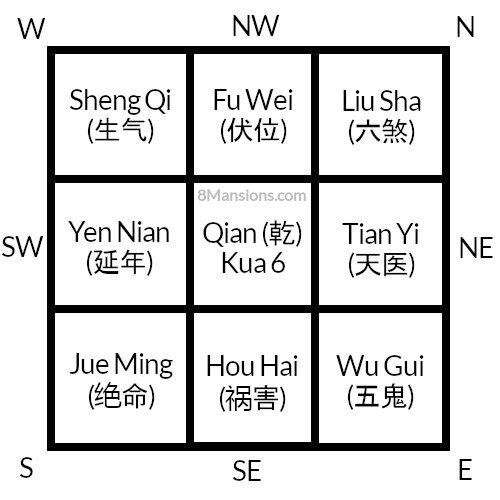
In this instance, it can be said that a Qian house would be ideal, or most suited, for someone with the Gua number 6.
The main difference in application of 8 mansions to property and to individuals is that the former is mostly focused on home sectors while the latter is focused on facing directions.
For example, a Kan house would have the Sheng Qi (SQ) direction at Southeast. Thus, it can be deduced that the southeast sector of such a house would be very favorable for a front door, home office, living room, or even a master bedroom. However if the sole breadwinner is Gua 9, then his SQ direction would be East. So even though the best location for a home office is at the southeast, it would be most desirable (in terms of wealth generation and success) for the breadwinner to have a desk and seat orientation that allows him to face East while working.
Otherwise, another simple application of personal 8 mansions feng shui is to make important calls facing the SQ direction.
Modern feng shui
In the modern practice of formula feng shui, the majority of master practitioners use a fusion of different feng shui concepts. The popular system being a blend of both Xuan Kong flying stars and Ba Zhai 8 mansions.
The most simple parts of both systems are extracted and laid over one another to get an overview of the energy map of a house and the family members.
In such cases, there are bound to be conflicts between the 2 schools of thought. And it would be up to the judgment and expertise of the practitioner to harmonize both concepts, or determine which one takes precedence over the other when harmony cannot be achieved.
Specialists of Ba Zhai who only apply 8 mansions in feng shui assessments are few and far between.